Capability
Is Capability Becoming an Organisational Responsibility?
From organisational learning to organisational capability.
9 min · Alshad Dustagheer
In the previous edition, I explored the distinction between learning and organisational learning. Central to that discussion was the idea that whilst individuals learn, organisations are increasingly expected to retain, transfer, apply, and sustain learning over time.
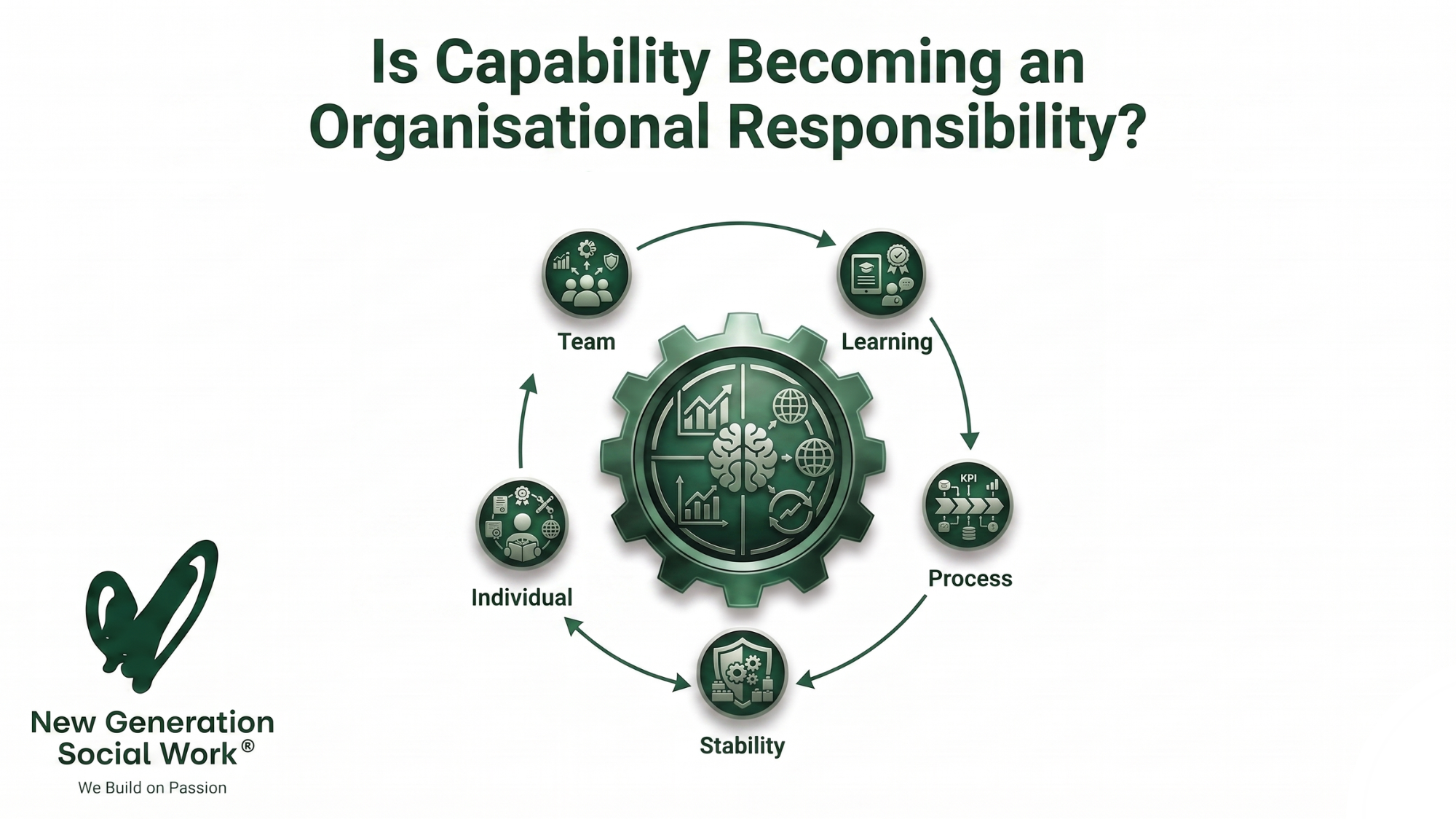
This naturally leads to another question: what does capability actually look like? Capability is a term that appears with increasing frequency throughout workforce development plans, professional standards, reform guidance, organisational strategies, and leadership discussions. Yet despite its widespread use, it often remains difficult to define in practical terms.
Knowledge remains an essential foundation of professional development, but capability appears to concern something broader. It is not simply what professionals know. Rather, it concerns how knowledge is applied, adapted, transferred, and sustained within real world practice environments.
Beyond Competence
Historically, much of professional development within social work has been shaped by concepts of competence — an individual's ability to demonstrate the knowledge, skills, behaviours, and professional standards required to perform a role safely and effectively.
Rather than focusing solely on whether professionals possess the required knowledge, the emerging emphasis appears to be on whether organisations can create the conditions through which knowledge can generate the intelligence to create effective practice.
Capability as an Organisational Achievement
For the purposes of this discussion, I define capability as the organisational ability to convert learning into consistent professional judgement, effective practice, and sustainable improvement that ultimately contributes to positive outcomes for children and families.
The question is no longer simply whether individual practitioners are capable. Increasingly, leaders may need to consider whether their organisations are capable of developing, supporting, and sustaining capable professionals over time.
What Might the Family Help Lead Practitioner Be Telling Us?
The Family Help Lead Practitioner role perhaps provides one of the clearest illustrations of the shift taking place beneath the surface. It reflects a growing expectation that capability should not be confined to a single profession but developed across a wider network of practitioners operating within integrated systems.
Capability is no longer solely concerned with the development of individual professionals within individual organisations. Increasingly, it appears concerned with the collective capability of partnerships to operate effectively across shared systems.
Leadership reflections
- —How is capability currently understood within your organisation?
- —What evidence exists that learning is strengthening professional judgement and decision-making?
- —How are capability expectations communicated across teams, services, and partnerships?
- —Where does capability sit within workforce development planning?
- —How might organisational capability be evidenced beyond training attendance and compliance measures?